


AirDroid Parental Control
SAND STUDIO
Keeping track of a child’s phone use is rarely about watching every tap. In my experience, the harder job is creating a routine that protects attention, gives parents useful context, and still leaves room for trust. AirDroid Parental Control approaches that job as a parenting app from SAND STUDIO, combining device controls with location tracking rather than focusing on screen-time charts alone.
I tested it with that practical question in mind: does it make everyday family coordination easier, or does it simply add another layer of supervision to manage? The answer depends heavily on what you need. Families looking for a way to block distracting apps, check a child’s location, and set clearer boundaries may find it useful. Parents who only want a basic timer, or who are uncomfortable with location monitoring, may prefer a simpler alternative.
A free starting point, with paid access clearly separated
The app is free to install, which makes it possible to explore its approach before committing money. That matters in this category because parental-control tools often become part of a family routine, and a feature that looks useful in a store description may feel awkward once both parent and child have to use it regularly.
There are in-app purchases listed from $9.99 to $89.99 per item. I would therefore treat the free access as an opportunity to test the basic experience, not as a promise that every useful control is permanently available without payment. The exact value of upgrading depends on which controls your family actually needs, so I would avoid paying immediately after installation.
The app has a 4.5 average from around 132 thousand ratings, with roughly 1.6 thousand written reviews. It has also passed 10 million installs, which suggests that it is not an obscure experiment. Those figures do not replace hands-on testing, but they do give some confidence that the product has been used widely enough for its general approach to be familiar to many families.
Latest News

Uber Eats Under Pressure: What Happens When Delivery Goes Wrong

How QR & Barcode Scanner Adapts to Android and iOS Innovations

Why Waze Navigation & Live Traffic Is Your Essential Travel Companion

CapCut Mastery: Unleash Hidden Features for Pro-Level Editing

How OS Updates Enhance Roblox Adventures

Teacher Simulator: Exam Time Turns Quick Classroom Judgments into a Repetitive Loop
Its content rating is Everyone, and the current version is 2.7.0.4. It works on Android 8.0 or later. That minimum requirement is reasonable for many existing phones, but families with an older spare device should check compatibility before planning a full setup around it.
What the app is trying to solve
The central idea is straightforward: combine an app blocker with a GPS tracker inside one parenting-focused tool. In practice, that means the app is aimed at two different concerns that often overlap. One is digital routine, such as reducing access to distracting apps during homework or bedtime. The other is physical reassurance, such as knowing where a child’s phone is when they are traveling between school, home, and activities.
I like that combination because parents usually do not think in separate product categories. A child leaving school with unrestricted gaming access and no clear way to check their location creates a broader problem than either issue alone. Having both functions in one service can make the conversation at home simpler: the family agrees on when certain apps are unavailable and how location sharing will be used.
Gallery
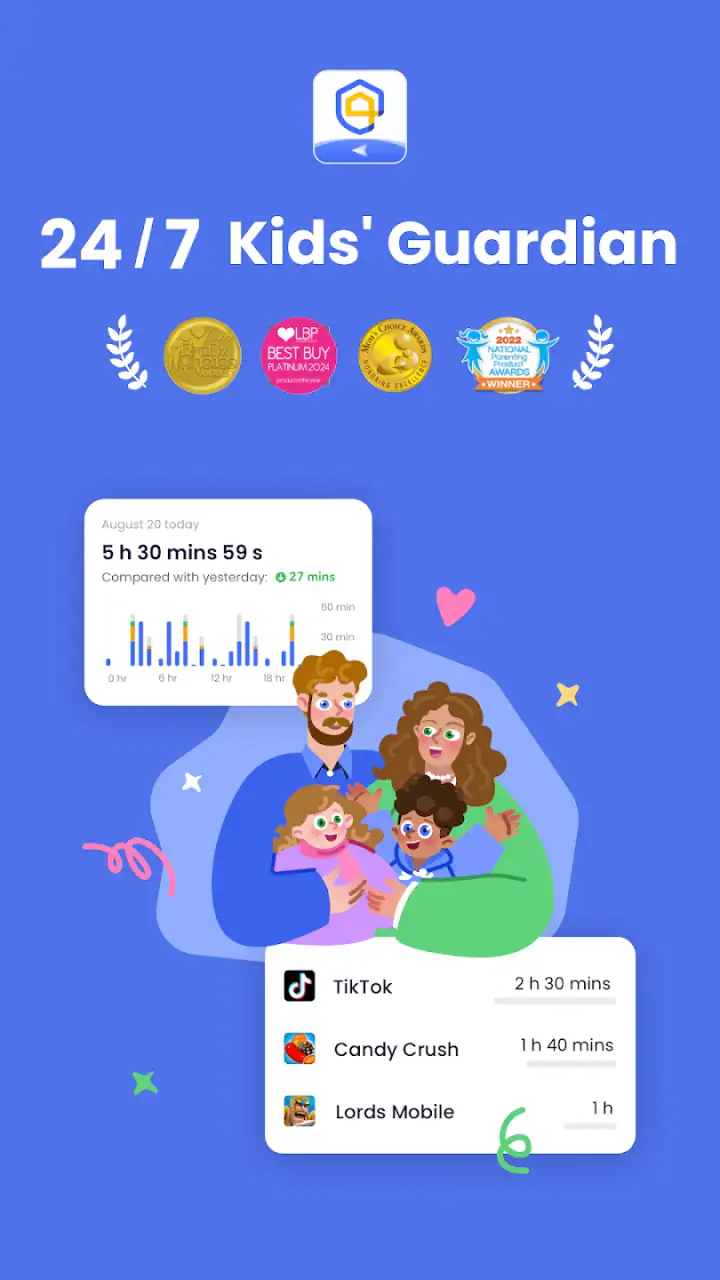
That convenience also creates the app’s biggest responsibility. Blocking applications is a household rule. Location tracking is much more sensitive. I would introduce the location feature openly, explain when it will be checked, and agree on reasonable boundaries with an older child. Using it secretly could damage trust even if the technical feature works perfectly.
How I would use it in an ordinary family routine
Imagine a child who comes home from school, needs to finish homework, and then has football practice. A parent could use the control side of the app to make the after-school period less tempting for games or social apps, then use the location side to confirm that the child has reached practice without sending repeated messages. Later, the restrictions can be relaxed for agreed leisure time.
The useful part is not simply pressing a block button. The real improvement comes from turning vague instructions into a repeatable routine. “Please put the phone away while studying” depends on constant reminders. A planned restriction gives the child a predictable boundary and gives the parent fewer arguments to have. I would still keep exceptions in mind, because a rigid rule can become a problem if a child needs a blocked app for schoolwork or an urgent family message.
A second practical use is travel. If a child is old enough to go to a nearby activity independently, location tracking can reduce the need for check-in texts. I would use it as a backup rather than a reason to stop teaching basic safety habits. The child should still know how to contact a parent, what to do if the phone battery is low, and why location sharing is enabled.
Small decisions that make the setup work better
One detail many parents overlook is that controls are only useful when they match the child’s real schedule. I would begin with one clearly defined period, such as homework, instead of trying to control the entire day. This makes it easier to see whether the restriction solves a genuine distraction problem or merely causes frustration.
I would also separate “apps that interrupt concentration” from “apps that are unsafe.” Those are not the same thing. A game may be distracting during study time but harmless at other times. A messaging app may be necessary for family coordination even when entertainment apps are blocked. Treating every application identically can make the system feel punitive and encourage children to look for workarounds.
Location tracking deserves its own agreement. Before enabling it, I would tell the child what is being shared and when a parent is likely to look. For younger children, the conversation may be brief; for teenagers, it should be more collaborative. The strongest use of this feature is reassurance during agreed situations, not continuous interrogation about every stop.
Another useful habit is to review the arrangement after a week. If the child is repeatedly asking for an exception, the schedule may be too strict or poorly timed. If the parent is checking the map constantly, the problem may be anxiety rather than a missing feature. No parental-control app can solve that underlying issue, and adding more monitoring may make it worse.
Where it feels stronger than simpler alternatives
A basic screen-time tool can be enough when the only goal is limiting daily phone use. AirDroid Parental Control is more appealing when a family wants device boundaries and location awareness together. That combination avoids switching between a separate blocking utility and a separate tracking service, and it gives the parent one place to think about the child’s digital and physical routine.
Compared with relying on built-in phone settings alone, the app is more specifically framed around parenting. That can be helpful for adults who want a dedicated family workflow rather than a collection of technical menus. It also makes sense for households with children who use phones in different ways, because the parent can focus on agreed activities and situations instead of treating the device as a single block of screen time.
However, built-in controls may be the better choice for a parent who wants the smallest possible setup. They are often less demanding because there is no separate parenting service to learn and maintain. If you only need a bedtime reminder or a general daily limit, installing a broader tool may be unnecessary.
A standalone location-sharing option may also suit families whose only concern is safe travel. In that case, paying for a more complete parental-control package could provide more supervision than the household wants. AirDroid’s value increases when both sides of its purpose matter; it decreases when one side is irrelevant.
The friction behind the convenience
The first source of friction is that parental controls work only when the family accepts the arrangement. A parent may find the controls useful, but a child may see them as intrusive. That is not a defect unique to this app, yet the combination of blocking and tracking makes the emotional side more noticeable. I would not recommend presenting it as a secret surveillance tool or as a replacement for conversation.
There is also an ongoing maintenance cost in attention. Schedules change, school projects need different apps, holidays disrupt routines, and children grow into different levels of independence. A setup that works for a younger child may feel inappropriate later. The app can support a family rule, but it cannot decide what that rule should be.
Location information can create false confidence too. Seeing a phone in a particular place does not prove that the child is safe, that the child is carrying the phone, or that the location is current enough for an emergency decision. I would treat the tracker as a helpful context tool, not as a substitute for direct communication or sensible safety planning.
The purchase structure is another point to consider. Since the app is free to install but offers in-app purchases ranging from $9.99 to $89.99 per item, I would compare the cost with how long the family expects to use the service and which paid controls are genuinely relevant. A high-priced option may be reasonable for a household that uses several functions every day, but it is difficult to justify for occasional location checks alone.
Who is likely to get real value from it
I see the strongest fit for parents of children who have started using a personal smartphone but still need structured support. The app can help when the family is dealing with repeated gaming during homework, late-night phone use, or uncertainty about whether a child has arrived at an activity. It is especially practical when the parent wants one system rather than separate tools for blocking and location.
It may also help co-parents who need a shared, consistent routine. The important point is not that every adult must enforce identical rules, but that the child should not receive confusing instructions from different people. A common control setup can reduce that inconsistency, provided the adults agree on the purpose and review the rules together.
Families should be more cautious if the child is old enough to expect substantial privacy and the parent has not discussed monitoring openly. In that situation, the technical convenience may not be worth the relationship cost. I would also skip it if the family has no clear need for app blocking or location tracking, because a simpler built-in option may be easier and less intrusive.
It is not the right answer for parents looking for a complete solution to online safety either. Blocking and location do not replace teaching children about strangers, scams, privacy, passwords, or uncomfortable messages. Those conversations remain necessary, and the app works best as one practical layer in a wider parenting approach.
My value judgment after using the full concept
AirDroid Parental Control delivers the most value when its two main jobs are both relevant: managing distracting apps and providing location awareness. The free installation lowers the barrier to trying it, while the paid range means I would make the purchase decision only after identifying a specific family problem that the upgrade solves.
I would recommend starting modestly. Set one routine, explain the location arrangement, and observe whether the app reduces conflict or simply moves the conflict into arguments about restrictions. If the family becomes calmer and the child understands the boundaries, the tool is earning its place. If the parent is constantly adjusting rules or checking the map, the setup needs reconsideration before more features are added.
My final verdict is positive but selective. This is a capable parenting app for families that want practical limits without juggling multiple services, and its broad adoption and 4.5 average suggest that many users find the approach worthwhile. I would choose it over a basic timer when location tracking genuinely matters. I would skip the paid path when the household only needs occasional screen-time limits, when privacy concerns outweigh convenience, or when the free experience does not fit the family’s routine.
In short, I see it as a tool for building clearer agreements, not for replacing trust. Used transparently and with flexible rules, it can make everyday supervision more manageable. Used as constant surveillance, it is likely to create more tension than value.
FAQs for AirDroid Parental Control
What is AirDroid Parental Control and how does it work?
AirDroid Parental Control is an app designed to help parents monitor and manage their children's device usage. It provides features such as screen time management, app usage tracking, and location monitoring. By installing the app on both the parent's and child's devices, parents can easily oversee and guide their child's digital activities.
Is AirDroid Parental Control compatible with both Android and iOS devices?
Yes, AirDroid Parental Control is compatible with both Android and iOS devices. Parents can download the app from the Google Play Store for Android devices and the Apple App Store for iOS devices, ensuring comprehensive coverage across different platforms for effective monitoring and control.
What kind of features does AirDroid Parental Control offer for managing screen time?
AirDroid Parental Control offers robust features for managing screen time. Parents can set daily screen time limits, schedule device usage, and even remotely lock devices to encourage healthy digital habits. The app provides detailed reports on device usage, helping parents understand and manage their child's screen time effectively.
How does AirDroid Parental Control ensure my child's privacy and data security?
AirDroid Parental Control prioritizes the privacy and security of your child's data. It complies with data protection regulations, ensuring that all information is encrypted and securely stored. The app only collects necessary data for functionality, and parents have control over what information is accessed and monitored.
Are there any subscription fees for using AirDroid Parental Control?
AirDroid Parental Control may offer both free and premium versions. The premium version typically requires a subscription fee, providing additional features and enhanced capabilities. It's important to review the pricing details on their official website or app store listing to understand the costs involved and select the plan that best suits your needs.
Pros
- Intuitive user interface for easy navigation.
- Real-time location tracking for peace of mind.
- Comprehensive app usage reports.
- Screen time management tools.
- Supports multiple devices.
Cons
- Limited features in free version.
- Occasional connectivity issues.
- Requires stable internet connection.
- Some features may drain battery quickly.
- User interface lacks customization options.


